History
Curriculum
History
History Curriculum
Intent, Implementation and Impact
"Everyone to Excel through Pride and Ambition"
Intent
At Montem Academy, our intention in History is to convey a greater understanding and knowledge of British and World History through lessons and experiences that stimulate children’s inquisitiveness and fascination.
Our History curriculum is progressive throughout the whole school and covers the knowledge and skills stated in the National Curriculum. The historical skills and knowledge acquired inspire our pupils to think and act as historians.
Through our high-quality teaching we will develop the following skills and knowledge:
- A secure knowledge of the people, events and contexts from a range of historical periods,
- An extensive base of historical knowledge and vocabulary,
- The ability to ask and answer valid historical questions,
- Draw conclusions and explain their findings,
- Use a range of resources to gather information and to follow lines of enquiry.
Implementation
At Montem Academy, History is taught in the first half of each term. Pupils are taught knowledge through high-quality lessons, trips and visits, whilst developing their key skills such as: chronological awareness, understanding historical context, and organising, evaluating and communicating information.
The areas of study are based on whole school themes. In the Autumn Term, pupils explore 'British History’, in the Spring Term, the pupils explore ‘World History’ and in the Summer Term, pupils explore ‘Kings and Queens'. These themes are then explored during literacy lessons; both reading and writing.
In Key Stage 1
Pupils are taught:
- Enquiry: To compare their life to significant people from the past and to find similarities and differences between the events of the past,
- Investigating and Interpreting the Past: photographs, artefacts and simple text to make comparisons,
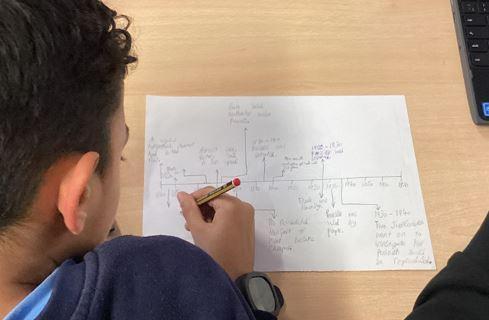
- Chronology: To place events in chronological order on a timeline, including artefacts, words and phrases and dates,
- Making Connections: To link changes in living memory to changes in national life,
- Communicate Historically: To use simple historical words and phrases to answer questions.
In Key Stage 2
Pupils are taught
- Enquiry: To explain the significance of events and clarify similarities and differences between cultural, social and religious aspects of a period,
- Investigating and Interpreting the Past: Explore different interpretations of the past through the impact of contrasting sources from the same time,
- Chronology: To demonstrate a deep understanding of the chronology of a series of events on a timeline and explain the impact of one event upon another. To use dates and terms accurately in describing events,
- Making Connections: To discern between past periods of time and societies analysing trends,
- Communicate Historically: To use historical vocabulary to ask and answer valid questions and to pursue lines of enquiry.
Impact
Our History Curriculum is age appropriate, and is planned to demonstrate progression across the main skills: enquiry, chronology, investigating and interpreting the past, making connections and communicating historically.
These main areas are broken down into age-related expectations for each milestone: Year 1 and 2, Years 3 and 4, Years 5 and 6. Pupils are assessed these expectations each term.
In addition, through reading age appropriate specifically selected texts, our children are exposed to the historical knowledge that they will need to become enthusiastic historians.
We assess the pupils' knowledge through:
- Low stake quizzes
- Pupil discussion
- Evidence in pupils' books
- Assessment against planned learning outcomes
History in Action
|
|
|
|